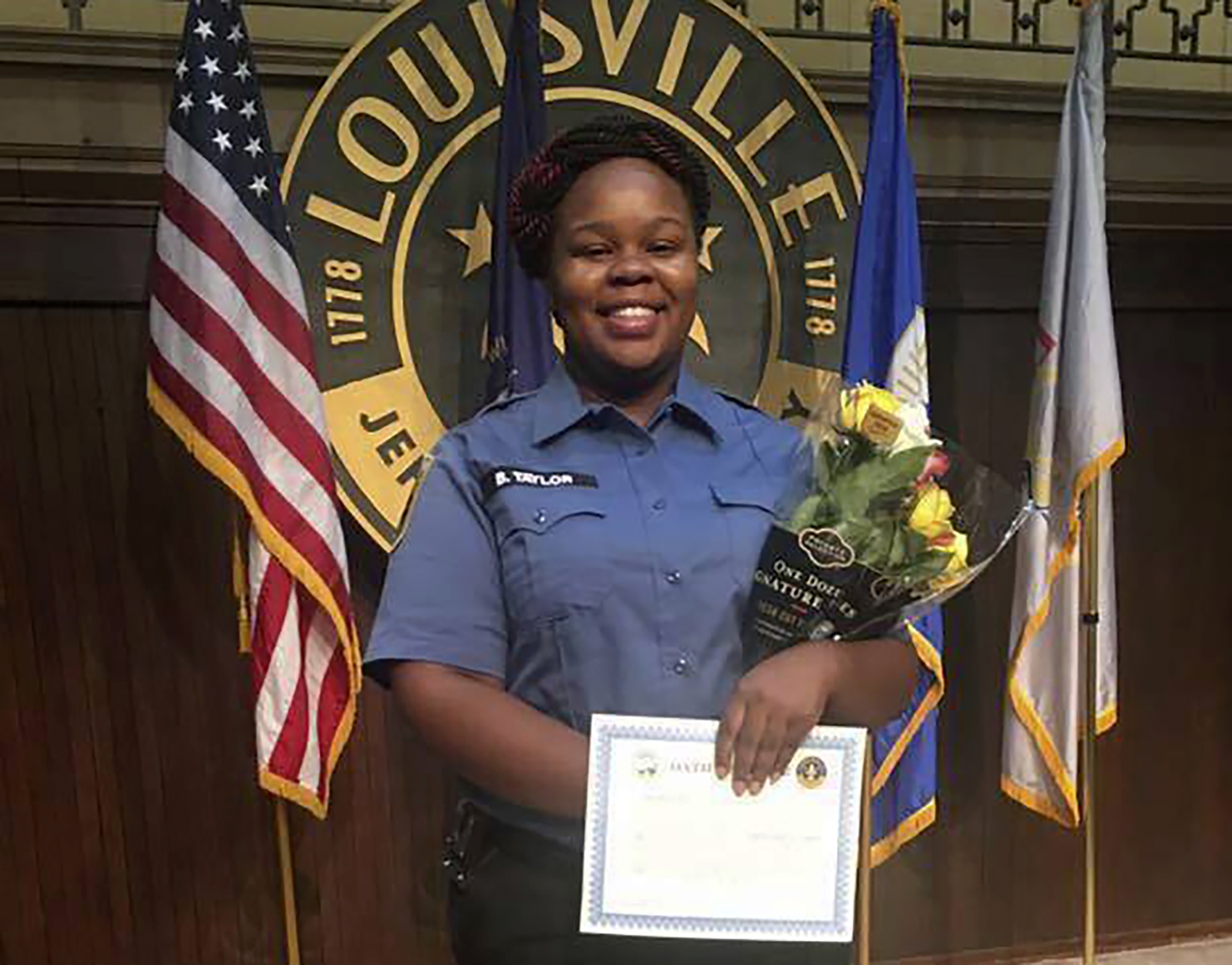
In a case that has attracted significant attention, the United States Department of Justice is arguing against a jail term for Brett Hankison, a former officer with the Louisville Metro Police Department. Hankison was earlier found guilty of violating rights under the pretense of legal authority for his conduct during the unfortunate 2020 operation at Breonna Taylor’s home, an event that sparked a national discussion on law enforcement methods and led to a federal inquiry into the Louisville department. This advice, detailed in a recent memo about sentencing, indicates a preference for a solution that excludes additional imprisonment for the ex-officer.
Hankison’s conviction in November stemmed from his conduct during the chaotic raid, where he discharged his firearm ten times into Taylor’s apartment. Prosecutors emphasized that his shots penetrated a window and a sliding glass door, both obscured by blinds and curtains, with several bullets traversing walls and entering an adjacent apartment. Crucially, none of Hankison’s bullets struck Breonna Taylor. The officers whose gunfire ultimately caused Taylor’s death were not charged in the incident, as their actions were categorized as returning fire after Taylor’s boyfriend, Kenneth Walker, discharged his weapon as police breached the residence.
The Justice Department’s sentencing memo, filed late on a Wednesday, articulated a nuanced perspective on Hankison’s actions. It stated that “reasonable minds might disagree as to whether defendant Hankison’s conduct constituted a seizure under the Fourth Amendment in the first place.” Furthermore, the memo asserted that there “is no need for a prison sentence to protect the public from defendant.” This position is notable given a February ruling by a judge who determined that sufficient evidence existed for a jury to believe Taylor was still alive when Hankison fired his initial five rounds through the bedroom window.
The Justice Department’s suggestion specifically calls for a sentence of just one day’s imprisonment, matching exactly with the period Hankison had already spent behind bars after being initially charged. Some critics highlight that this sentencing proposal was not supported by the experienced line prosecutors within the Justice Department’s Civil Rights Division. Rather, it was signed by Robert J. Keenan, a senior advisor in the Civil Rights Division appointed during the Trump administration. Keenan has been linked in the past with the Justice Department’s attempts to contest a jury’s decision that convicted a former Los Angeles County deputy of a felony related to excessive force, adding another dimension to the debate about the department’s position.
The setting for this suggestion includes the important changes happening in the Civil Rights Division of the Justice Department. Beginning in January, there have been major revisions in both policies and staff, resulting in a significant departure of long-standing professionals. This situation has sparked discussions about how political appointments and alterations in policy might affect the management of delicate cases such as Hankison’s.
In the sentencing memorandum, the Justice Department also highlighted the atypical aspects of this case, pointing out that it “has no record of another instance where a police officer was prosecuted for violating another individual’s rights under the Fourth Amendment by returning gunfire and not causing harm to anyone.” This comment seeks to place the legal uniqueness of this case in context, which may set it apart from other legal actions concerning police misconduct.
The memo further highlighted the protracted legal journey to secure a conviction against Hankison, noting that “two federal trials were ultimately necessary to obtain a unanimous verdict of guilt.” Even then, “the jury convicted on only one count,” despite the elements of the charge and the underlying conduct being “essentially the same” across multiple counts. Hankison had also been acquitted on a state charge related to the incident, preceding the federal proceedings.
“Here, multiple prosecutions against defendant Hankison were brought, and only one of three juries — the last one — found him guilty on these facts, and then only on one charge,” the memo elaborated. Despite this, the Justice Department conveyed its respect for the jury’s verdict, predicting that it would “almost certainly ensure that defendant Hankison never serves as a law enforcement officer again and will also likely ensure that he never legally possesses a firearm again.” This suggests that even without additional prison time, the conviction carries significant professional and personal consequences for Hankison.
The Justice Department’s sentencing recommendation has not been universally well-received. Samantha Trepel, a former official in the Justice Department’s Civil Rights Division, expressed strong dissent in a LinkedIn post. Trepel specifically recalled that bullets fired by Hankison had “missed a sleeping baby by about two feet” during the raid. She characterized the Justice Department’s request as a “transparent, last minute political interference into a case that was tried by non-political, longtime career prosecutors who obtained this conviction in front of an all-white jury of Kentucky citizens before a Trump-appointed judge.” Her comments suggest a deep-seated concern among some legal professionals about the perceived political motivations behind the sentencing recommendation, particularly as it diverges from what might be expected in a case involving deprivation of civil rights.
Hankison is scheduled for sentencing on July 21. The judge overseeing the case will ultimately determine whether to accept the Justice Department’s recommendation or impose a different sentence. The decision will undoubtedly be closely watched as a gauge of accountability in high-profile police misconduct cases and the ongoing debates surrounding justice and law enforcement in the United States.